
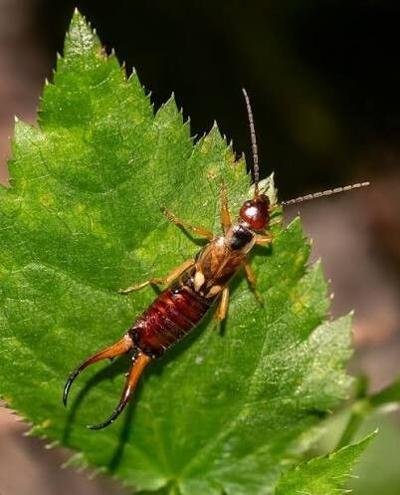
Master Gardeners had many discussions with shoppers at the Yakima Farmers Market this week about earwigs. They seem to be especially abundant in Yakima gardens this year.
Though an old European myth claims they burrow into human brains through the ear while the victim is sleeping, earwigs are harmless to humans.
In fact, earwigs can be beneficial predators in your garden, eating soft-bodied insects such as aphids, mites and insect larvae. They are also valuable scavengers that break down decaying organic matter, enriching your soil in the process. But they can also become garden pests, chewing holes in seedlings, flowers and soft fruits.
While earwigs may look intimidating, they use those forceps-like pincers for defense and capturing prey. Although harmless to humans, they can cause visible damage in Yakima gardens.
鈥� Appearance: Earwigs are about 3/4 inch long, dark brown and have visible pincers at the tail end. Females have mostly straight pincers, while males have larger, more distinctly curved pincers.
鈥� Signs of damage: They chew irregular holes in leaves, petals and fruit. The damage is similar to that caused by slugs, but earwigs do not leave a telltale slime trail.
鈥� Favorite targets: They love seedlings, soft fruits such as strawberries, apricots and peaches, sweet corn, and flowers including marigolds and dahlias.
If earwigs are causing damage in your garden, there are several ways to reduce their numbers.
鈥� Remove hiding places: Earwigs thrive in dark, damp environments during the day. Clear away excess mulch, leaf litter and garden debris near plant beds. Move boards, stones and unused pots away from the base of plants. Prune the lower leaves of leafy vegetables, such as cabbage or broccoli, so they don't rest on the soil.
鈥� Adjust your watering schedule: Because earwigs love cool, moist soil, you can make your garden less appealing by changing how you water. Water deeply, but less often. Water in the morning so the soil surface can dry before nightfall, when earwigs become active.
鈥� Set DIY traps: Fill a small, shallow container, such as a tuna can, with vegetable oil and a little bacon grease or tuna oil. Bury it so the rim is level with the soil. Earwigs will crawl in and drown.
Another option is to dampen a newspaper or magazine, roll it up, secure it with a rubber band and place it in the garden in the evening. By morning, earwigs will crawl inside to hide. Shake them into a bucket of soapy water or simply discard the paper trap.
For more information about controlling earwigs on specific crops, visit .听
Remember, if you're not seeing damage, you may want to let the earwigs continue helping control other insect pests in your garden.



(0) comments
Welcome to the discussion.
Posting comments is now limited to subscribers only. or log in using the link below. For additional information on commenting click here.
Log in
Keep it Clean. Please avoid obscene, vulgar, lewd, racist or sexually-oriented language.
PLEASE TURN OFF YOUR CAPS LOCK.
Don't Threaten. Threats of harming another person will not be tolerated.
Be Truthful. Don't knowingly lie about anyone or anything.
Be Nice. No racism, sexism or any sort of -ism that is degrading to another person.
Be Proactive. Use the 'Report' link on each comment to let us know of abusive posts.
Share with Us. We'd love to hear eyewitness accounts, the history behind an article.