
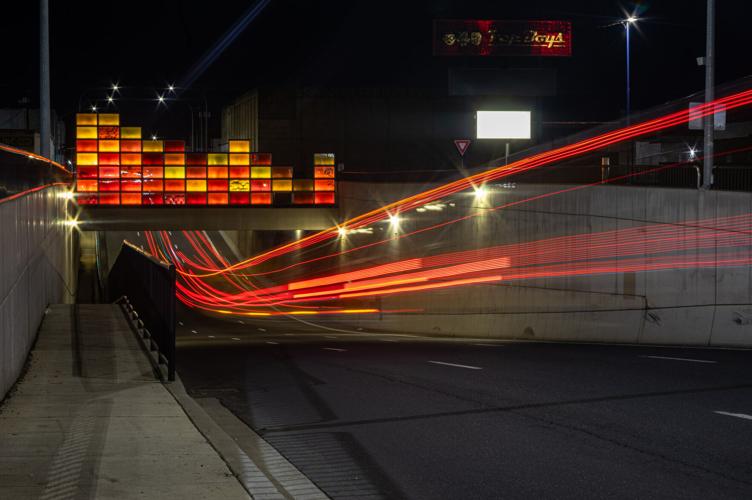
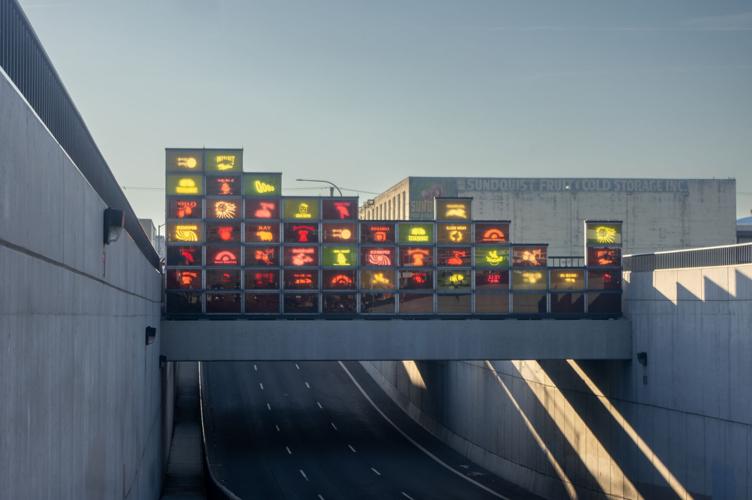

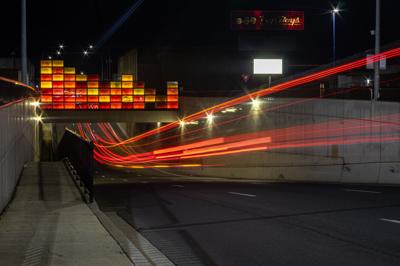
For eight years, drivers on East Lincoln Avenue have passed under one of Yakima鈥檚 more controversial public artworks.
鈥淏ins of Light,鈥� a series of lighted, colored glass panels that pay homage to Yakima鈥檚 fruit industry, was the culmination of more than a decade of planning and debate before it was finally installed, and even then, it drew complaints from people convinced it was put up incorrectly.
(Spoiler alert: It鈥檚 supposed to be that way.)
The project was first conceived in 2001, when plans were made for underpasses at what are now Lincoln Avenue and Martin Luther King Jr. Boulevard. The underpasses would allow North Front Street and the BNSF railroad tracks to pass over the streets without the need for traffic signals or gates.

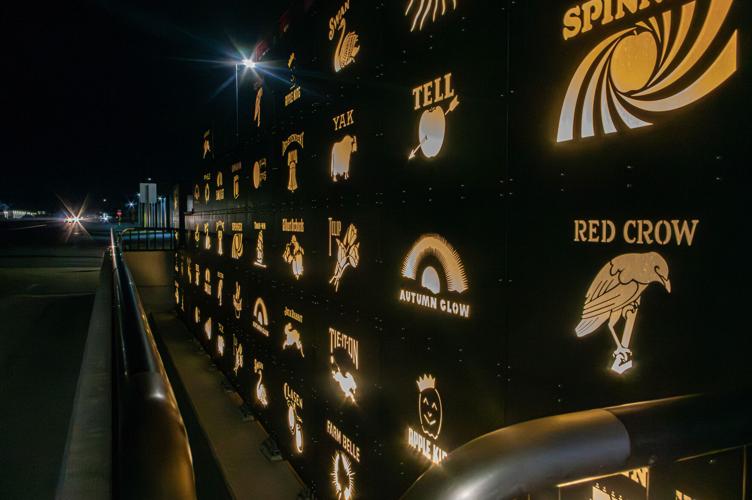
The North Front Street side of the "Bins of Light" include representations of some well-known fruit labels.
Then-Mayor Mary Place and Bill Cook, who was the city鈥檚 economic development director at the time, proposed putting public artwork on the completed structures.
The idea would sit there until 2007, when the city named an ad-hoc committee to solicit proposals for the artwork. Elizabeth Herres Miller, the former Allied Arts director, chaired the committee.
In 2008, when the $42 million budget for the underpass projects was announced, the committee settled on a proposal from Seattle artists Laura Haddad and Tom Drugan. The artists conceived 鈥淏ins of Light鈥� as a way to pay tribute to the region鈥檚 agricultural industry.
"It was one of the most awesome community pieces we have done," Drugan said in a recent phone interview. "It came through well."
Drugan said he and Haddad were inspired by the fruit bins they saw near warehouses and how they were being stacked and unstacked.
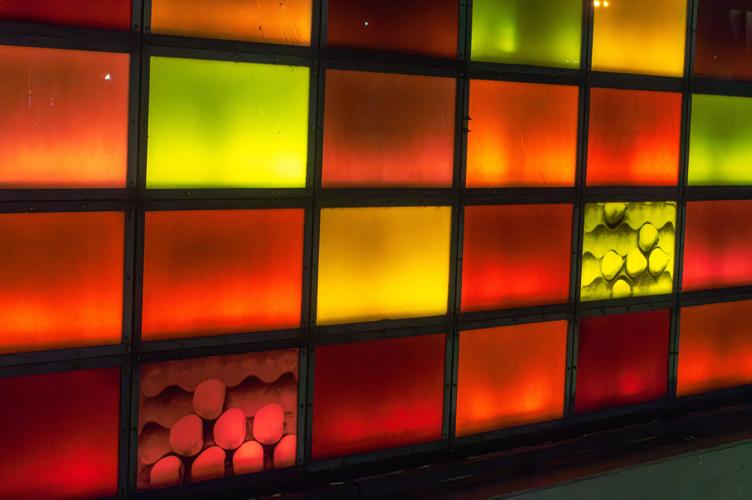
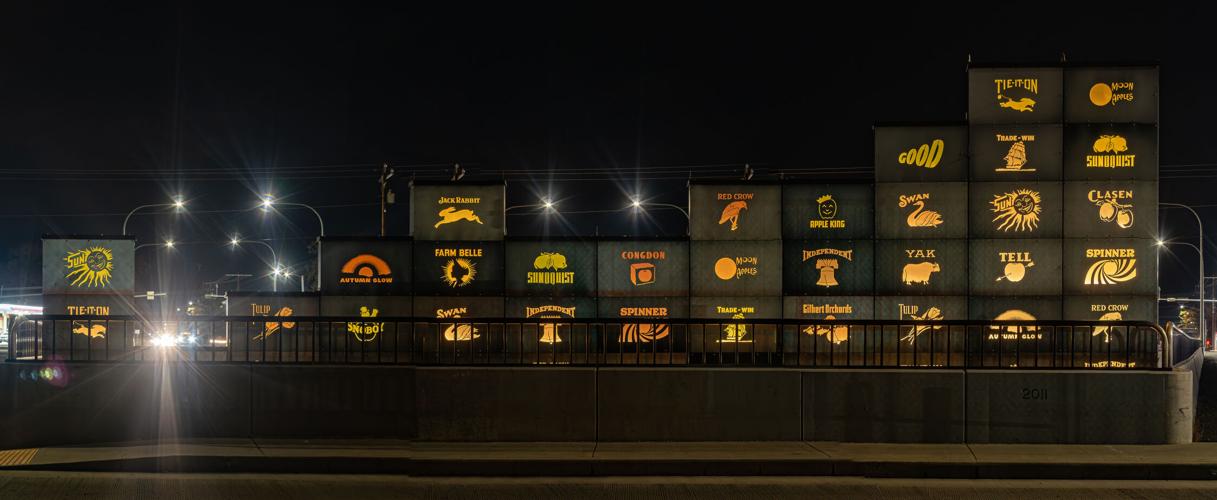
The concept called for a 鈥渒inetic electric-light sculpture鈥� consisting of 56 glass panels cut to the size of fruit bins and arranged as if they were stacked by the warehouses on nearby Fruit Row. Some of the panels would have images of fruit in packing trays.

Some of the panels in the "Bins of Light" have depictions of packed fruit on them.
The 鈥渂ins鈥� would聽be lit with LED light strips at night that would turn off and back on as trains passed in the evening, symbolizing the unloading and loading of fruit.
On the other side were laser-cut aluminum panels with simplified versions of some of the fruit labels that graced fruit bins and boxes from the Valley鈥檚 growers. Haddad and Drugan worked with residents to pick which fruit labels would be displayed.
Drugan said that was a good experience, in that they were able to learn some of the back stories behind the labels and the growers they represented.
As Haddad and Drugan explain on their website, the concept was to have a play of light both day and night, with the sun providing illumination in the daytime hours, particularly as the afternoon sun shone through the panels.
The original art budget for both underpasses was set at $700,000, increasing to $750,000 by 2010.
But as happens with many public works projects, the underpasses were hit by cost overruns, which delayed construction. The final budget for the underpasses wound up at $43 million, a mix of federal grants, with $5.5 million in federal funding covering the funding gap for the Lincoln Avenue underpass.
The underpasses were completed by the middle of 2014, but the 鈥淏ins of Light鈥� were still incomplete due to debate over funding commitments by the city.

The fruit-label stencils on the back of the "Bins of Light" are seen from North Front Street in a series of photos that were stitched together.
The council committed to the project, allocating $450,000 from the funds leftover after the underpass construction. But there were still a couple more hurdles. One of those was working out an agreement with the Millennium Foundation on who would maintain the artwork, as well as getting the glass panels, which were made in Germany, through U.S. Customs.
The piece, which is 17 feet tall at its highest point, was installed in spring 2017. And starting at its final construction and through its first year, it drew complaints from people convinced that whoever installed it royally screwed it up.

The afternoon sun shines through the fruit-label stencils on the back of the "Bins of Light" in Yakima. The artists intended for the labels to appear in reverse when backlit.
When the sun shines through from the back, the fruit-label stencils are visible to drivers on East Lincoln Avenue, but they鈥檙e backward. They appear in their 鈥渃orrect鈥� orientation from North Front Street.
That led to many letters to the editor from people complaining about it and demanding that the artwork be 鈥渇ixed.鈥�
that the artwork is correct, and the original intention was to have the reverse image of the labels appear on the glass when illuminated by the setting sun.
The design was always intended to be two sided, though not all the labels are visible from a vehicle on Front Street.
鈥淲e had to attach the art to the strut and wanted the glass panels to begin on the strut," Haddad said in a 2017 Herald-Republic article. "Therefore, the bins are fully visible from the primary side, on Lincoln, but not from a car on Front Street. If we had wanted to make all the labels visible from Front Street we would have had to elevate the entire artwork, which was a structural non-starter and would have made the glass side look strange.鈥�
Former Mayor Micah Cawley said he liked the finished product, despite it not being exactly what he thought it would be. The alternative was an underpass decorated by 鈥渁 big slab of concrete,鈥� he said in 2017.
Drugan said the placement of the label panels was deliberate, as they were part of the pedestrian element of the piece, where people walking by could closely examine the label panels, as well as see them glow in the early morning when the sun shines through the colored glass.
The piece is one of the largest public art fixtures in the city, behind Dick Elliott鈥檚 鈥淐ircle of Light鈥� on the 黑料福利社 SunDome.
It Happened Here is a weekly history column by 黑料福利社 reporter Donald W. Meyers. Reach him at dmeyers@yakimaherald.com or 509-577-7748. Sources for this week's column include and the archives of the 黑料福利社.






(0) comments
Comments are now closed on this article.
Comments can only be made on article within the first 3 days of publication.