
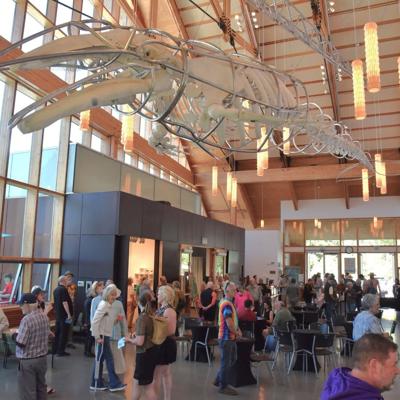
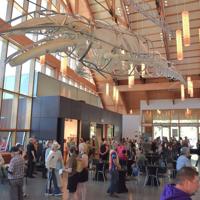
VASHON ISLAND — Bob Lane leaned back in his chair in the middle of the Vashon Center for the Arts atrium and gazed up at the 39.5-foot gray whale skeleton above him.
From the tip of the whale’s metal tail, a slow wave traveled through the vertebrae and into the long curve of his spine — a quiet, tidal motion that made the skeleton appear alive.
“This is amazing,� Lane said, wide-eyed and laughing, struck by seeing the whale’s bones come alive for the first time.
Lane is one of about 100 volunteers who helped make all this happen. But he also remembers the bones before they were cleaned, slick with blubber and heavy with the smell of decomposition.
Just two years ago, the bones now suspended from the arts center’s tall atrium ceiling lay a couple of miles away, inside the body of an adult gray whale washed ashore on a Vashon Island beach.
He could have disappeared the way many stranded whales do — towed away, sunk or left to the tide.
Instead, the whale became Singer, named for his species’ ability to vocalize and the music venue where his bones were stored for a time.
Over the next two years, Singer’s bones would move from shoreline to classroom to workshop — and finally to the arts center atrium, where the sculpture was unveiled June 20.
Here, Singer will undulate overhead for at least the next five years, serving as a visual and emotional reminder of the challenges facing gray whales as the climate changes — and as a springboard for lectures, student programming and conversations about ocean health.
A species under strain
When , gray whales were emerging from what scientists had called an , marked by a yearslong period of elevated deaths, said Bianca Perla, science director of Vashon Nature Center, which led the effort to recover, study and reassemble Singer's bones.
This year, the concern has returned. Washington is again seeing .
had been documented in Washington this year, already the second-highest annual total ever recorded in the state. The most common finding among examined whales has been malnutrition, sometimes accompanied by trauma consistent with vessel strikes.
“Right now they (gray whales) are barometers of ocean health, and that’s telling us something’s going wrong because they’re not being able to be supported at the level that they should,� Perla said.
Singer was an adult male, part of the Eastern North Pacific population — the long-migrating group that travels between Baja California and Arctic feeding grounds. When he died in April 2024, Perla said, he was on his way north, partway through
He showed signs of starvation and osteoporosis. His body, Perla said, told a story scientists are increasingly seeing in gray whales: animals that depend on Arctic food webs now being forced to survive in a changing ocean.
Gray whales feed heavily during a few months in northern waters, consuming bottom-dwelling invertebrates that rely on a food chain tied to sea ice algae.Â
As ocean temperatures rise and Arctic ice changes, Perla said, the food webs gray whales rely on have become less reliable — a shift driven in part by greenhouse gas emissions. “We worked so hard to protect the gray whales by curtailing hunting, and now we might lose them if we don’t curtail emissions,� Perla said.
Still, Perla said the installation was meant to tell a hard environmental story without draining it of awe.
“I love that it has a little life in it,� Perla said. “I feel like a lot of indoor nature installations are all about dead, statuesque animals, and you don’t get the feel that you do for their beautiful movement and their life force.�
From beach to classroom
Singer’s body remained on a Vashon shoreline long enough to decompose naturally, allowing volunteers to document the process before collecting the bones.
The bones were then moved to The Coop, a local music venue that had sufficient space, where they dried.Â
From there, . In a greenhouse on the Vashon Island High School campus, ninth graders — and a section of the marine science class — studied, measured and drew the bones, guided by scientific nature illustrator Annie Brulé.
Their field-note drawings became part of Singer’s record and are now displayed near the whale through July.
“Art and science, when they hold hands, are stronger than either on their own,� Brulé said. “Especially when it comes to communicating to the public and inviting folks in to be citizen scientists.�
Brulé said she hopes the process of slowing down, drawing and sitting with the animal helped students understand the power of close attention — and how that attention can speak to a community.
“When we bring that understanding through our heads and hearts, through our hands, onto the page — to a problem that needs solving, or a scientific question that wants answering — that’s when some really potent work can happen,� Brulé said.
One of the most technically demanding student contributions came from Sophie Phillips, a 15-year-old islander with an interest in archaeology. Sophie scanned nearly every one of Singer’s 164 bones, except the skull. Those digital scans helped engineers and fabricators assemble Singer digitally before his bones were raised into the atrium.
Scanning the bones was more difficult than Sophie expected, she said, but the work affirmed her interest in archaeology: “It really helped to make me more confident that this is truly the career path I want.�
The scans also created a lasting scientific record of an individual gray whale — a rare resource, Vashon Nature Center staff said, for a species familiar along the coast but still not as thoroughly documented as its size and presence might suggest. They are now available through the exhibit’s interpretive kiosk and for educational use by request, with scientific publication planned in the next year.
Maria Metler, the center’s education director, said Singer became more significant than anyone first understood — a massive physical undertaking, but also a sentinel whose death signals something larger about the health of Puget Sound and the ocean beyond it.
“It’s easy to look at Puget Sound, with its pristine waters and mountains behind it, and think things are healthy,� Metler said. “But Singer presents a reality that’s hard to ignore.�
Suspended at VCA
By September 2025, Singer’s bones had reached artist , a Vashon Island sculptor known for kinetic, metal and nature-based work. For months, the whale filled his workshop and his life.
Lamblin made clear he was not there to simply assemble a skeleton or create a scientific display. He wanted to make art — to evoke the whale’s living form, not just connect bone to bone. He added metal lines to suggest volume and girth, along with metal baleen and a tail fluke, the powerful part of the whale a skeleton alone cannot fully show.
“I wanted to create the living being,� Lamblin said. “This is not a corpse, and it’s not a skeleton. It’s a being.�
To Perla, Lamblin’s work gave Singer back what starvation had taken: a sense of fullness, movement and life.
Not every bone made it into the final sculpture. Some smaller bones were never recovered, likely washed away by the tide, while others — mostly finger and wrist bones in the fin display, along with one pelvic bone — were 3D printed.Â
A few recovered bones, including sternum pieces, were left out as Lamblin and the Nature Center balanced anatomical accuracy with the visual demands of the sculpture.
The tail movement, designed with Vashon Island engineer Rob Wheeler, sends a wave through the whale’s body. Lamblin described it as a sine wave, supported by a flexible spring running through the tail vertebrae.
“It’s uplifting and inspiring,� Lamblin said of the movement. “There’s a lot of sadness around the death of these whales going on. So we need to celebrate their life as well.�
Many of Lamblin’s sculptures are connected to the natural world. He believes educating the public beyond the scientific community is a gap that art can bridge.
“The more people have awe and wonder and understand about these creatures, the more they’ll care,� Lamblin said. “The more they care, the more they’ll be willing to take action and do something about it.�
When Vashon Nature Center proposed bringing Singer to Vashon Center for the Arts, the answer was immediate.Â
For Allison Reid, VCA executive director, and Lynann Politte, gallery director, the whale fit the arts center’s mission: a public artwork rooted in science, education and community — and a real, suspended, 3,000-pound lesson in how those disciplines meet.
“That’s the power of art: to create a message, to create an emotion in the other person, and then ultimately to take action,� Politte said.
The installation was logistically enormous. Singer arrived in early June in pieces — body, head and flippers. Doors were removed, rigging was installed and structural questions had to be answered before the whale could be raised into place.
Unveiled at VCA’s 60th birthday bash last month, the sculpture will be accompanied by lectures, docents, student programming and climate education tied to the installation, over at least the next five years. Reid emphasized that the building is public; no ticket is required to sit in the atrium and look up.
For the Nature Center’s Metler, the whale’s presence in the atrium makes visible something many people can otherwise avoid seeing: the immense problems behind Singer’s death.Â
But she also sees the scale of the project itself — the effort it took to raise him into the air — as a reason to leave with something beyond loss.
“If you can leave with a sense of wonder and curiosity about whales and our reliance on a healthy ocean system, that is what I hope people take away,� Metler said.
Above her, Singer’s tail moved again, sending a ripple through the skeleton now suspended above the atrium.
For a moment, in the glass-walled heart of the arts center, the whale swam.





(0) comments
Welcome to the discussion.
Posting comments is now limited to subscribers only. or log in using the link below. For additional information on commenting click here.
Log in
Keep it Clean. Please avoid obscene, vulgar, lewd, racist or sexually-oriented language.
PLEASE TURN OFF YOUR CAPS LOCK.
Don't Threaten. Threats of harming another person will not be tolerated.
Be Truthful. Don't knowingly lie about anyone or anything.
Be Nice. No racism, sexism or any sort of -ism that is degrading to another person.
Be Proactive. Use the 'Report' link on each comment to let us know of abusive posts.
Share with Us. We'd love to hear eyewitness accounts, the history behind an article.