

A Seattle Immigration Court official popped his head into Judge Hayden Windrow's courtroom late Tuesday afternoon.
"Are you done?"
"Yeah," said the judge.
"Amazing. Absolutely amazing."
"Congratulations, your honor," added the U.S. Immigration and Customs Enforcement prosecutor in the room.
"Just like having a baby, except not nearly as fun," Windrow said. "I'm surprised my voice didn't give out."
The judge had just finished a marathon hearing representing a new Trump administration tactic. Begun nationwide in the spring and hitting Seattle in late June, the tactic involves calling in an unusually large number of people at a time for a preliminary "master calendar" hearing in deportation proceedings. The number on Windrow's docket that day: 117.
As a point of comparison, other judges in the Seattle court had between seven and 35 people scheduled for preliminary hearings Tuesday.
The administration suggests these new "mega masters," as they have been dubbed by court watchers, are meant to speed up deportation cases that have tended to lag for years.
"Reducing the immigration court backlog remains one of the highest priorities for this administration," the U.S. Department of Justice, which oversees immigration courts, said in a statement responding to questions about mega masters. The courts, another statement said, make "scheduling adjustments as needed to ensure cases do not languish."
Immigrant advocates and at least one scholar who have watched mega masters play out across the country suspect another purpose: racking up as many deportation orders as quickly as possible.
"Mega master hearings is scheduling gone mad, but madness with a purpose: manufacturing deportations at the expense of due process," said Syracuse University research assistant professor Austin Kocher in a .
Master calendar hearings are often pretty boring affairs. Similar to arraignments in criminal court, one person at a time is called before the judge, who asks some basic questions. Do they need a change of address form? Do they want to apply for asylum? If unrepresented, do they want time to find a lawyer before proceeding? If so, the judge will typically schedule a new master calendar hearing, saving for later the question of whether they admit to the government's charges of being deportable.
These hearings are nevertheless absolutely essential to attend because a no-show in most cases results in an "in absentia" removal order.
Such orders have been piling up in mega masters held in New York, California, Georgia and elsewhere. In the last week of May alone, judges nationwide issued roughly 2,200 at such hearings, representing 40% of those scheduled to appear, , a website analyzing publicly available immigration court data.
The post's authors, independent researcher Joseph Gunther and civic technologist Brandon Marrow, attribute the high number of no-shows in large part to courts scheduling people to appear on short notice, in some cases two weeks or less. In the past, people have tended to get at least a couple of months' notice, according to Marrow and others familiar with immigration courts.
A long lead time is helpful because people often have to request time off work and make childcare and transportation arrangements, advocates say. The court may also have an outdated address to send hearing notices to. A lot of people don't know how to change their address with the court, said Yakima immigration lawyer Stephen Robbins. "They might go to a local ICE office and say I've moved," not realizing they need to inform the court separately, he said.
So Seattle immigrant advocates worried in the run-up to mega masters here — expected to be held as often as once a week for adults and families and daily between July 7 and July 10 for juveniles who entered the country on their own. The Northwest Immigrant Rights Project posted a urging people in deportation proceedings to check an every day to make sure they know when their next hearing is.
Seattle's first mega master rolled out on June 23 in Judge Brett Parchert's courtroom, located along with his colleagues' courtrooms in the Henry M. Jackson Federal Building downtown. On his docket were 105 people, according to Deborah DeWolfe, part of a group of volunteers supporting immigrants attending hearings.
The court had lined up chairs in the hallway to accommodate the expected crowd — one that didn't materialize. "It was really like planning for a big event, and no one came," DeWolfe said. Volunteers estimate about two-thirds of the 56 people scheduled for the morning were missing, most of whom likely received removal orders.
Before mega masters, the average percentage of absentia removal orders at preliminary hearings in Seattle's immigration court hovered around 10% under former President Joseph Biden and 25% under President Donald Trump, according to Gunther and Marrow of .
Gunther deduced one possible reason for the high number of no-shows in the first mega master's morning session: Twenty-four people had originally been scheduled for a hearing two days later. The court rescheduled them for a new date a month ago.
Far more people arrived in the afternoon, and the judge issued only a few removal orders, sparing one person who didn't appear because she just had a baby, according to Alex Alonso, a Northwest Immigrant Rights Project legal advocate who was there.
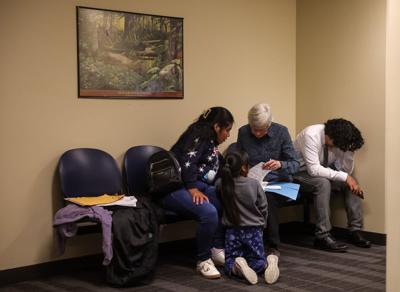
As the second mega master got underway Tuesday, people arrived in droves, this time filling the seats placed in the hallway until court staff began calling them into the courtroom in groups. They came from as far away as Spokane and Yakima and Pennington, Ore., some with children also placed in removal proceedings.
"I think word is getting out more that if you don't come to your hearing you're likely to get a removal order," said DeWolfe, the volunteer, who helped people fill out change of address forms and handed out flyers listing legal and other resources.
While two people said they had gotten this hearing date when they first crossed the border into the U.S. in 2023, others got a letter from the court in late May. One woman, who like others there that day asked not to be named, said she had only gotten the hearing notice a couple of days ago because it had been sent to her sister's house, and her sister belatedly passed it on.
A couple with a 9-year-old child said they didn't get a letter at all telling them their hearing date had been moved to this day. They found out about the new date from an app many immigrants use to track court dates.
Santos Mendoza-Mendoza also said she found out about the hearing date, initially scheduled for a different day, online. She clutched a folder emblazoned with a photo of her former lawyer, , who gave up her license amid a lawsuit and accusations of misconduct by the state bar. Mendoza-Mendoza said she paid Lozano’s now-closed law firm thousands of dollars, but it hadn't communicated the new time nor supplied an attorney to attend the hearing with her as promised.
Windrow politely worked his way through the crowd, telling Mendoza-Mendoza he was "deeply sorry" for her experience with a firm that had "imploded in scandal" and offering her more time than usual to find a new lawyer. Except for that and the volume of people, the proceedings seemed mostly unremarkable. But they were momentous for about 22 people ordered removed throughout the day because of their absence.
One person, who was out of town, tried to attend through an online portal the court sometimes uses, according to Adam Graham-Silverman, a volunteer who was in the courtroom at the time. The man's attorney was there and said she had trouble reaching her client to remind him of the hearing date. The judge, conferring with the ICE attorney, declined to let the man out of the online portal's waiting room and issued a removal order.
Windrow issued most of the other removal orders at the end of the morning and afternoon sessions. Practically speed-talking, he ticked off people's names and case numbers, then asked the ICE attorney how he wanted to proceed. "In absentia," the attorney invariably said, and the judge complied. Each order took roughly a minute.
Kayley Bebber, a Northwest Immigrant Rights Project attorney heading its unaccompanied juveniles program, said she hopes this week's mega masters will have "more of a child-friendly lens" that won't result in automatic removal orders for those who fail to show up.
The hearings before Judge Theresa Scala are likely to be a scene either way. According to , roughly 400 children are throughout the week in Seattle.






(0) comments
Comments are now closed on this article.
Comments can only be made on article within the first 3 days of publication.