
BIG FOUR MOUNTAIN 鈥� You can tell a lot about a forest by the mosses, lichens and liverworts you find there.
Some of these nonvascular plants, or bryophytes, even hint at changes to the towering geologic and ice formations to which they owe their existence.
Miles Berkey squats and brushes his fingertips along a patch of lanky moss () growing at the base of a tall silver fir. A jeweler鈥檚 loupe dangles from a worn red lanyard around his neck. He uses the tool often to more closely inspect species in the field. On a tree just a few paces south, softball-sized clumps of hanging moss () dot the trunk. You can catch marbled murrelets, small seabirds, .
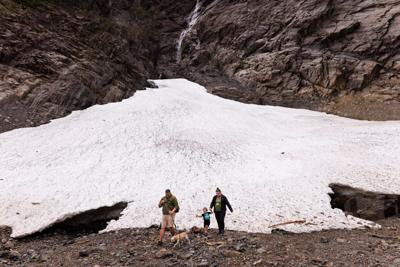
These species give Berkey a notion that he鈥檚 standing in an older section of forest, left relatively undisturbed for generations. But not far away, the signs change much quicker than you鈥檇 expect. Less than a mile down the trail, the sheer, north-facing cliffs of Big Four Mountain and the massive ice formation collecting at its base create an environment all their own.
Over the course of many millennia, this spot in the upper reaches of the Stillaguamish River鈥檚 south fork has proved resilient to the whims of broad heating and cooling trends, scientists believe. But now even these so-called Big Four Ice Caves 鈥� some 90 miles northeast of Seattle 鈥� are succumbing to the Pacific Northwest鈥檚 hotter, drier summers and winters with dwindling snowpack. This year might well be the first time in living memory that the caves melt away entirely, a sign of how severe the global and regional warming trends have grown, said Mauri Pelto, a glaciologist at Nichols College in Massachusetts, who has closely studied the region鈥檚 glaciers for years.
鈥淎lmost like it鈥檚 the last canary alive,鈥� Pelto said.聽
Closer to Big Four, mountain hemlock emerges, a tree Berkey said normally lives about 2,000 feet higher in altitude. Increasingly, trunks stand broken at the top. Leaves and branches tilt almost entirely toward the north, likely in one direction by avalanche flows year after year. Now, Berkey, a scientist who also owns and operates Cordilleran Ecological Surveys, takes a clue from the absence of mosses on the trees, which may well have been swept clean by fast-moving rivers of snow rushing from the mountain.
Ahead stands something of a scavenger hunt, a search through the unique, almost alpine microclimate created by Big Four Mountain and its ice caves. Berkey鈥檚 quarry: rare mosses and liverworts, which generally only live hundreds of miles to the north, in stretches of Canada and Alaska.
The Big Four Ice Caves
While the towering Big Four Mountain might be the first thing to catch the eye of the thousands of hikers and explorers who visit each year, the way it鈥檚 situated serves as one of the most important factors in creating the environment below.
The mountain鈥檚 upper reaches sit facing a perfect zero degrees north, said Doug Park, a geologist at Western Washington University. This blocks much of the sunlight year-round, casting a large shadow for plants and wildlife. But what makes this spot even more unusual is the steep drop-off from the top of the mountain, some 4,000 feet to its base.
Not only does this tuck the valley floor deeper into the mountain鈥檚 shadow, but any snow that accumulates on the north face avalanches down frequently and collects at the bottom in a unique type of glacier (Berkey calls it a 鈥済lacierette鈥�). The snow compacts to ice and creates a permanent formation there. As winter turns to summer, snowmelt bores holes into the ice, allowing warm air to pass through, growing these holes into large caves.*
*Do not enter the caves. The ice formations are ever-shifting, and unpredictable avalanches mean the caves can easily collapse. Multiple have been in (and near) the caves in the last few decades.
Cool, dark and damp (the area sees some 140 inches of precipitation each year, Berkey said), precisely the kind of conditions mosses and liverworts love.
Mountains and cliffs surround the entire valley, forming a sort of steep bowl that offered some protection in the area from the Cordilleran ice sheet and other glaciers tens of thousands of years ago, maintaining more consistent climatological conditions, which held on even as the ice age faded.
Now, more than 100 species of bryophytes live at the base of Big Four Mountain, some hardly found anywhere else in the contiguous 48, Berkey said. The bryologist cataloged them for his master鈥檚 thesis. Not only are many of these species crucial to maintaining biodiversity in an increasingly homogenous environment, but they also provide a glimpse into the past, when these species were more common. Even knowing where they鈥檝e clung to life here, they can be difficult to find.
The hunt
A sun dog hung in the sky on a particularly pleasant morning in late June. Berkey squinted as he crept toward a low but vertical rock face near the ice caves, its location kept intentionally vague so as to discourage any foragers from trampling the specimen.
The first species on Berkey鈥檚 list is so rare in Washington state that it鈥檚 really only known to live in a tiny patch in this valley, which has now shrunk to about the size of a beverage coaster. And its footprint is shrinking further, forcing Berkey to creep and kneel as he searches for the right spot. He places each step with care, inspecting potential candidates through his loupe.
At last, after orienting himself against a familiar rock (and cross-referencing with a photo from last summer), Berkey finds his old friend, the false apple moss (Bartramiopsis lescurii), which grows in small tufts 鈥� normally a demure olive green, though closer to a brown when dried.聽
This species can only be found around Big Four or nearby around Lake 22 or Mount Pilchuck, Berkey said. Although, he hasn鈥檛 been able to relocate the moss at those other locations and perhaps they鈥檝e died off.
Berkey smiled. He wasn鈥檛 sure he would be able to find this one. Not too many people know its location, and this time of year, when everything dries out, one species can be difficult to distinguish from another.
He bushwhacks a little farther away to a second, nondescript location full of hulking boulders. Berkey ducks into the nooks and crannies, kneeling, crawling and squinting in the shadows until he finds a leafier species, the gouty moss (Oedipodium griffithianum).
This is the only confirmed location in the state, and he鈥檚 pleased to see that the tiny specimen has sprouted little sporophytes, tiny and thin reproductive organs reaching upward, capped in an earthy orange. That鈥檚 an even rarer find.
As luck would have it, mixed into the patch is a liverwort that鈥檚 also so rare it has only been confirmed within the state here, Macrodiplophyllum imbricatum.
Not bad for a few hours searching. Normally, you鈥檇 find these species only hundreds of miles to the north and at much higher altitudes, Berkey said. But this is a special place, and the scientist relishes the chance to explore the now-familiar terrain and understand more of the natural world that most never take the time to consider.
These species and their decline serve as subtle indicators of our rapidly warming planet. If we don鈥檛 pay attention now, the knowledge they offer about this place and our past could be lost forever.
鈥淟ike so many things with climate change, they could just go away quietly without saying anything,鈥� Berkey said.
Melting ice
And conditions are certainly deteriorating, said Pelto, the glaciologist, who tracks several glaciers in the Pacific Northwest and has kept a close eye on the Big Four Ice Caves for more than a decade.
This was the country鈥檚 second-warmest winter on record, leaving Washington with a dismal snowpack. The warmest winter passed just two years ago. The region鈥檚 precipitation is increasingly falling as rain rather than snow. Not only does this cut into the avalanches necessary to form these caves, but it also translates to a severe water shortage across the state and beyond.
Not in living memory have the ice caves melted away entirely, Pelto said. They shrink each year, sure, but there鈥檚 always something left by the time the winter snows return. The summers of 2005 and 2015 (also notorious drought years) were the closest the caves have come to vanishing, he said. Those years, the formations shriveled to cover less than 1/100th of a square kilometer. But the following years brought enough snow for them to bounce back.
This year is different, Pelto said. Last summer brought drought (as did the two years before that), and there hasn鈥檛 been any respite. So this summer it鈥檚 anyone鈥檚 guess as to whether the ice will survive.
To be clear, the caves won鈥檛 disappear forever, Pelto said. They鈥檒l continue to form each winter, so long as there鈥檚 enough snow. But this warming trend will turn what was once a year-round formation into a seasonal one, underscoring the severity of the worsening global-warming trend.
Precisely what that will mean for the rare mosses, liverworts and other plants remains to be seen, Berkey said, but the chance would surely inject even more instability into the environment.
It鈥檚 also sure to change how even casual hikers see the valley. Jason and Marsha Rice drove up to see the caves with their young son, Patrick, and dog, Cashew, one recent morning. They expressed concern over the warming trend and noted that the ice is what brought them north. If it鈥檚 gone, they wouldn鈥檛 have made the drive from Marysville.
鈥淚鈥檓 not coming out to see a wall,鈥� Jason Rice said.
Like the rest of us, Pelto can鈥檛 predict the future, but he鈥檒l know more in, say, August about the ice's fate. Maybe then he鈥檒l be able to say a bit more definitively how fast this new era might come to this unique corner of the Pacific Northwest.







(0) comments
Welcome to the discussion.
Posting comments is now limited to subscribers only. or log in using the link below. For additional information on commenting click here.
Log in
Keep it Clean. Please avoid obscene, vulgar, lewd, racist or sexually-oriented language.
PLEASE TURN OFF YOUR CAPS LOCK.
Don't Threaten. Threats of harming another person will not be tolerated.
Be Truthful. Don't knowingly lie about anyone or anything.
Be Nice. No racism, sexism or any sort of -ism that is degrading to another person.
Be Proactive. Use the 'Report' link on each comment to let us know of abusive posts.
Share with Us. We'd love to hear eyewitness accounts, the history behind an article.